
-
Quality of life - Health - Food
DRCM / Cytogenetics Platform (PF-CytoG)
Technological platform
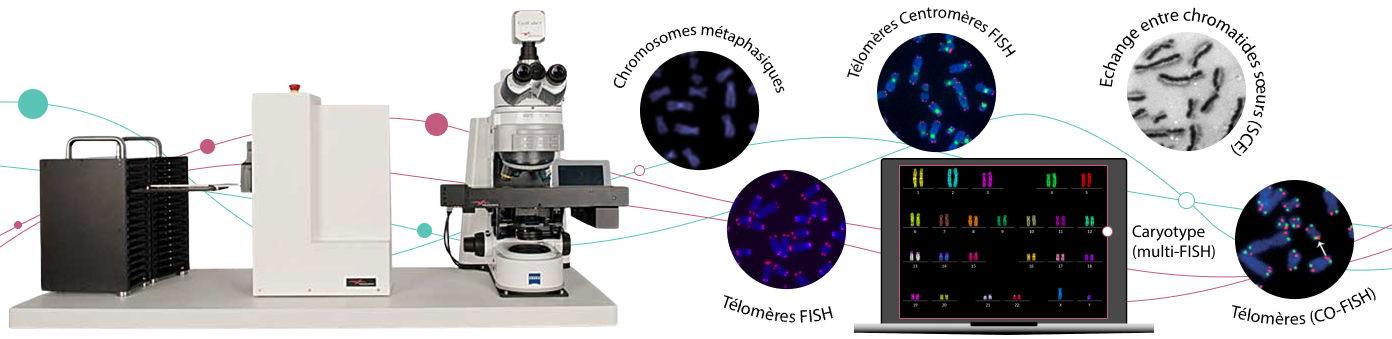
The PF-CytoG cytogenetics platform of the Department of Cellular and Molecular Radiobiology (DRCM) at the CEA specializes in the analysis of chromosomes and their abnormalities, including both numerical and structural aberrations. The platform provides expert cytogenetic services to academic and industrial research teams, supporting a wide range of scientific projects.
Cytogenetic analyses contribute to characterization of cells exposed to chemical compounds or generated through genetic engineering, and ensure the quality control of chromosomal stability during cell culture. Using a variety of sample types (cell lines, primary cultures, induced pluripotent stem cells (iPSCs), blood samples and organoids), the platform performs metaphase chromosome spreads and implements several molecular cytogenetic techniques based on Fluorescent In Situ Hybridisation (FISH). These include karyotyping by Multi-FISH (M-FISH) using commercial probes, as well as targeted analyses of specific chromosomal regions such as telomeres and centromeres. These approaches allow the investigation of chromosomal rearrangements and telomere aberrations, monitoring telomeric length dynamics using Telo/Centro-FISH, and the analysis of telomeric sister chromatid recombination by Chromosome Orientation-FISH (CO-FISH). The platform also performs conventional cytogenetic techniques, such as Giemsa staining, which, when combined with thymidine analogue incorporation enables the detection of sister chromatid exchanges (SCEs), a well established marker of genetic toxicity.
The platform uses a cytogenetic drying chamber to ensure the quality and reproducibility of metaphase spreads and is equiped with state-of-the-art infrastructure, including a Zeiss Imager.Z2 microscope, a robotic arm and specialised software that enable automated metaphase detection and high-throughput image acquisition with a capacity of up to 80 slides.
Finally, the PF-CytoG platform works in close collaboration with other DRCM platforms to provide integrated, project-specific solutions that best meet the needs of each research project.
Cytogenetic analyses contribute to characterization of cells exposed to chemical compounds or generated through genetic engineering, and ensure the quality control of chromosomal stability during cell culture. Using a variety of sample types (cell lines, primary cultures, induced pluripotent stem cells (iPSCs), blood samples and organoids), the platform performs metaphase chromosome spreads and implements several molecular cytogenetic techniques based on Fluorescent In Situ Hybridisation (FISH). These include karyotyping by Multi-FISH (M-FISH) using commercial probes, as well as targeted analyses of specific chromosomal regions such as telomeres and centromeres. These approaches allow the investigation of chromosomal rearrangements and telomere aberrations, monitoring telomeric length dynamics using Telo/Centro-FISH, and the analysis of telomeric sister chromatid recombination by Chromosome Orientation-FISH (CO-FISH). The platform also performs conventional cytogenetic techniques, such as Giemsa staining, which, when combined with thymidine analogue incorporation enables the detection of sister chromatid exchanges (SCEs), a well established marker of genetic toxicity.
The platform uses a cytogenetic drying chamber to ensure the quality and reproducibility of metaphase spreads and is equiped with state-of-the-art infrastructure, including a Zeiss Imager.Z2 microscope, a robotic arm and specialised software that enable automated metaphase detection and high-throughput image acquisition with a capacity of up to 80 slides.
Finally, the PF-CytoG platform works in close collaboration with other DRCM platforms to provide integrated, project-specific solutions that best meet the needs of each research project.
Innovation themes
18 route du Panorama
Commissariat à l’Energie Atomique et aux Energies Alternatives - Paris-Saclay, site de Fontenay-aux-Roses, DRF/JACOB/DRCM/PF-CytoG
92265 Fontenay-aux-Roses
Technologies utilisées
Cell culture (cell line, primary culture, iPSC), Metaphase chromosome spreading, Karyotyping (Multi-FISH), Detection of chromosome rearrangements and telomere aberrations (Telo/Centro-FISH), Sister chromatid exchange (SCE), Telomere recombination between sister chromatids (CO-FISH), Immunostaining combiend with FISH, Automated metaphase detection, Automated high-throughput microscopy for acquiring transmitted light or fluorescence images (up to 80 slides)Keywords
Types de prestations
- R&D Collaboration
Offres de prestations
The CytoG platform offers a range of services: - development or optimisation of the protocol for preparing metaphase chromosomes from different human or mouse samples (cell line, primary culture, genetically engineered cell, iPSC, organoid, etc.)use of molecular cytogenetic techniques to establish the karyotype (Multi-FISH), analyse chromosomal and/or telomeric aberrations, monitor changes in telomere size (Telomere-Centromere-FISH), study recombination between sister chromatids (SCE) or telomeric recombination between sister chromatids (CO-FISH), - automated acquisition of images in transmitted light or fluorescence by high-throughput microscopy (up to 80 slides) with automatic search for metaphases, analysis of cytogenetic data, - training of students, researchers and professionals.
Offres de formations
The CytoG platform, which welcomes students, researchers and professionals, offers practical training in the preparation of metaphase chromosomes from a variety of samples, their labelling using the various conventional or molecular cytogenetic techniques (karyotyping, M-FISH, FISH, telomere/centromere-FISH, CO-FISH, SCE, Giemsa), automated image acquisition with metaphase search and data analysis to study the cell karyotype, its stability or changes, telomere stability and changes in telomere size. These training courses, adapted to all levels, will enable participants to become more autonomous, faster and more powerful in their analysis, while benefiting from the technologies of the CytoG platform and the expertise of its staff.
Establishments of affiliation

Département(s) de recherche
- SDV (Life sciences)
Certifications
- Other